Experienced state employees can deliver big savings on infrastructure

This policy brief is based on:
U.S. infrastructure is crumbling, but rebuilding it—and improving it—is getting more expensive by the day. In the latter part of the 20th century, real spending per mile on Interstate construction increased more than three-fold.
What’s behind these cost increases, and how can we reverse the trend?
Past research revealed that slow, cumbersome processes around permitting drive up infrastructure costs. Now, research using project-level infrastructure data from Zachary Liscow (Yale Law School), Cailin Slattery (UC Berkeley), and William Nober (Columbia) finds that strengthening “state capacity” to build–in particular states’ ability to retain expert engineers–can make a big dent in the cost of infrastructure projects.
What We Learned
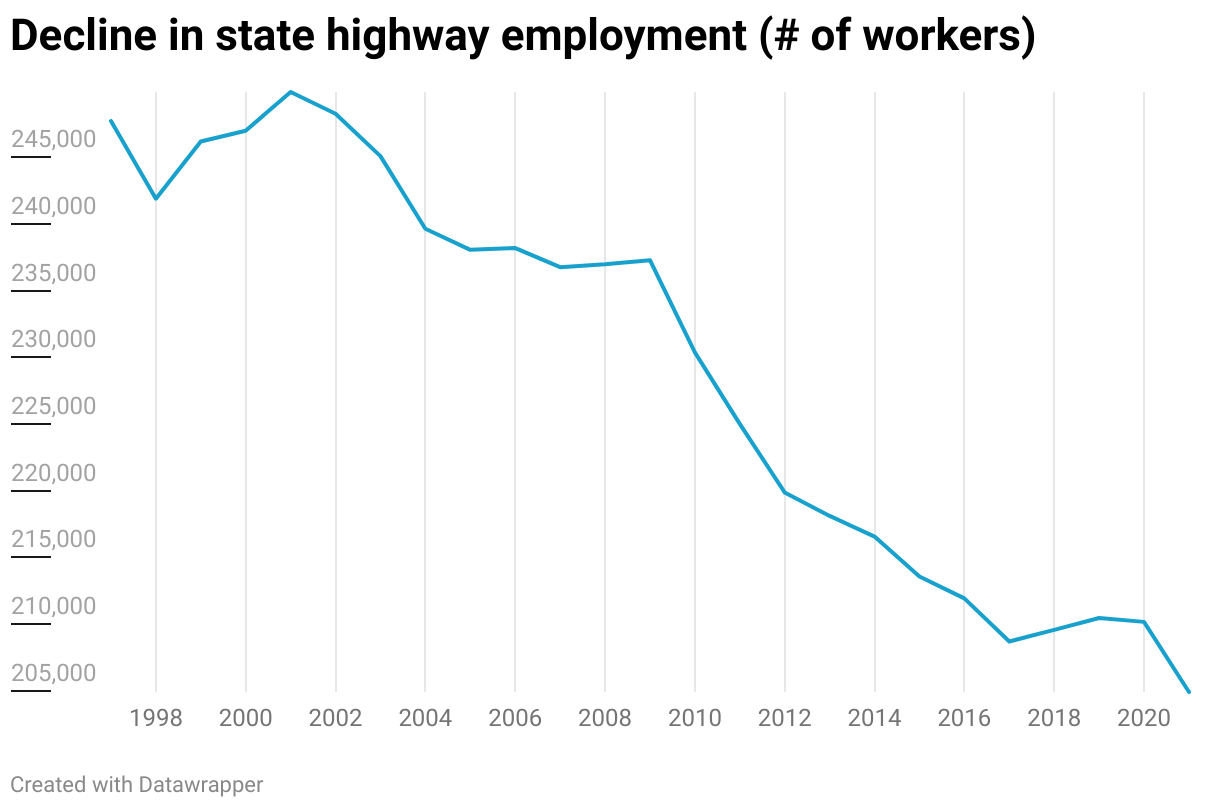
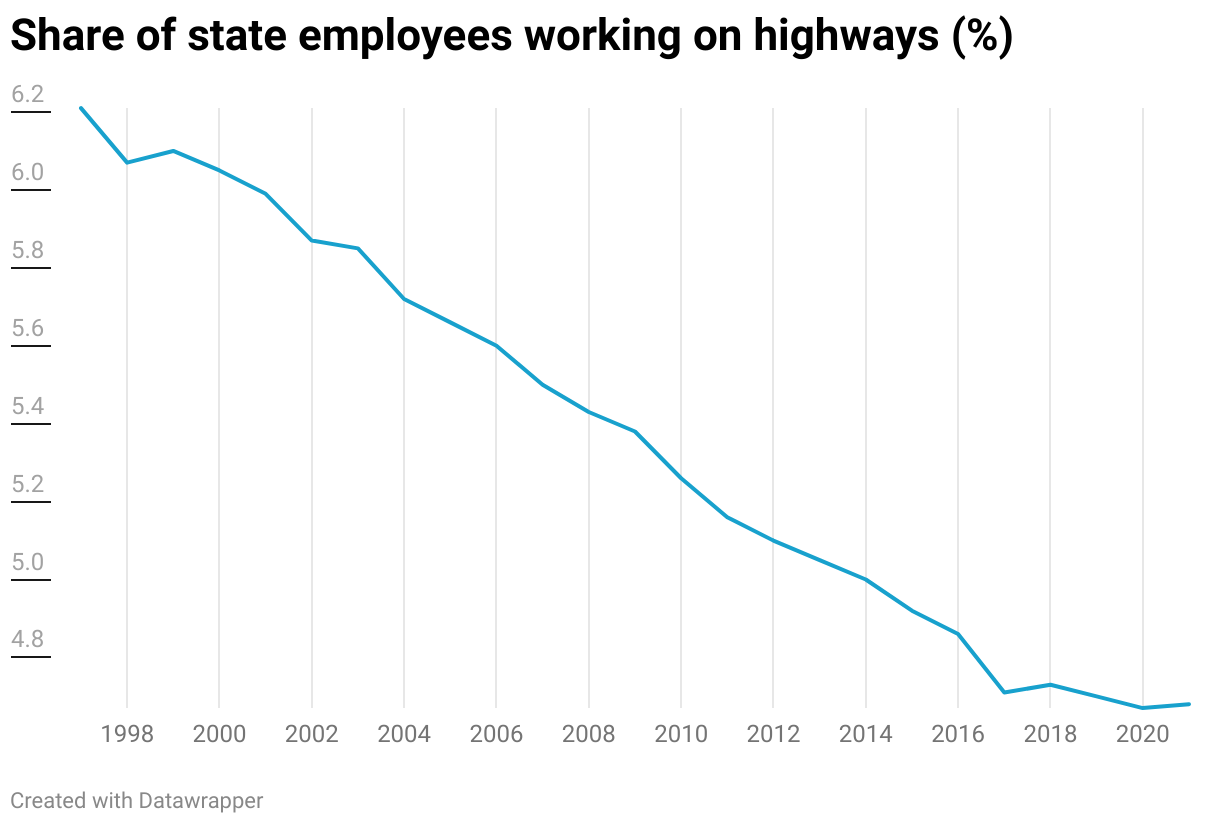
- Across the country, state Departments of Transportation (DOTs) are shrinking. State DOT employment has experienced a substantial decline in the last 20 years. Today, agencies are losing experienced staff and struggling to hire and train new staff to replace them.
- When DOTs are understaffed, project costs are higher. Comparing resurfacing projects across states, the researchers find that one additional DOT employee per 1,000 residents is correlated with 26% lower costs at the project level. When understaffed, state transportation agencies rely on contractors. This can push up prices in several ways, for example expensive change orders that result from poor project management on the state agency side. When resurfacing highways, one additional change order is associated with a $25,000 increase in cost per lane-mile, on average.
- High-quality engineers can drastically reduce project costs. In California, the DOT (Caltrans) employs more than 7,000 engineers across 12 geographic districts and the state headquarters. The researchers find that a single high-quality engineer can save Caltrans up to $750,000 a year. Engineers ranked in the 75th percentile of quality can deliver projects for 14% less than those ranked in the 25th percentile of quality, amounting to savings greater than three times the average engineer's salary.
- One important way better engineers reduce costs is by getting more bids from more contractors. Although one additional bidder is associated with 8.3% lower highway resurfacing project cost per mile, survey responses suggest 70% of states rarely do outreach.
- Engineer retirements are driving up costs. The cost increases resulting from an experienced engineer’s departure is six times as large as their wage. Survey responses suggest that complex agency rules and requirements can lead to mistakes by newer employees, which in turn create project delays and increase costs.
Policy Takeaways
The new research shows that improving state capacity to manage infrastructure projects can reduce costs in several ways.
- State agencies that oversee infrastructure projects need to hire and retain experienced staff. This research shows that if the government is going to provide public goods, but does not have the capacity to do so well, costs will likely rise instead.
- Experienced engineers more than pay for themselves, and states should be willing to pay more—perhaps a lot more—to retain them. In California, experienced engineers can retire with a pension from the public sector at a relatively young age and go on to make more in the private sector, oftentimes consulting for the government. A back-of-the-envelope analysis by the researchers suggests that California’s DOT should be willing to increase the compensation of high-quality engineers by over $300,000 a year in order to prevent them from leaving for the private sector. For comparison, the maximum annual salary for a senior engineer at the DOT is $168,000.
- Governments should redouble efforts to streamline hiring and make it easier to hire and retain the highest-quality workers. Cumbersome hiring and promotion rules that make it more challenging to hire and retain high-quality engineers also look especially costly given these results.
- Experience is particularly important for managing procurement. Infrastructure procurement can be extremely complicated. This paper is the first to study how individual engineers affect the procurement process. It finds that an individual employee can greatly affect project costs.
Data and Methodology
To better understand what drives up the cost of infrastructure projects, the researchers do three things. First, they survey employees of state Departments of Transportation (DOT) and private contractors. Second, they analyze and compare the cost and efficiency of highway resurfacing projects across all 50 U.S. states. Third, they study all highway construction projects in the state of California from 2011-2018.
For their survey of DOT employees across all 50 states, the researchers followed the general framework of the World Bank Doing Business “Contracting with the Government” survey. They collected 123 responses from DOT officials in 50 states, and 211 survey responses from contractors in 47 states.
The analysis of highway resurfacing projects across all 50 states relies on a first-of-its kind data set, collected via public records requests, that covers project-level costs of highway resurfacing projects in each U.S. state.
In California, the researchers study all highway construction projects from 2011 to 2018. The data is unique because it includes the identity of two Caltrans engineers assigned to each project. This is combined with data on salary, benefits, and retirement packages for engineers.
Related Work
Liscow, Zachary. 2025. “Getting Infrastructure Built: The Law and Economics of Permitting.” Journal of Economic Perspectives.
In the US, permitting is slow, infrastructure is expensive, and environmental outcomes are not particularly good. Reforming the power of the executive branch to decide and its capacity to plan would help.
Brooks, Leah and Liscow, Zachary. 2023. “Infrastructure Costs.” American Economic Journal: Applied.
Real spending per mile on Interstate construction increased more than three-fold from the 1960s to the 1980s. Increases in income and housing prices explain about half of the increase in spending per mile.The rise of “citizen voice” in government decision-making caused increased expenditure per mile.